2000 METERS TO ANDRIIVKA, The Definitive War Film

Few films dare to place you so completely inside an experience that you forget you're watching one. 2000 METERS TO ANDRIIVKA does exactly that, transporting us to the Ukrainian frontline with an uninterrupted, subjective relentlessness that leaves no room for comfort, distance or detachment. This is trench warfare not as spectacle, but as suffocating, knife-edge reality — the soldier's world in all its terror and razor-thin margin between life and death.
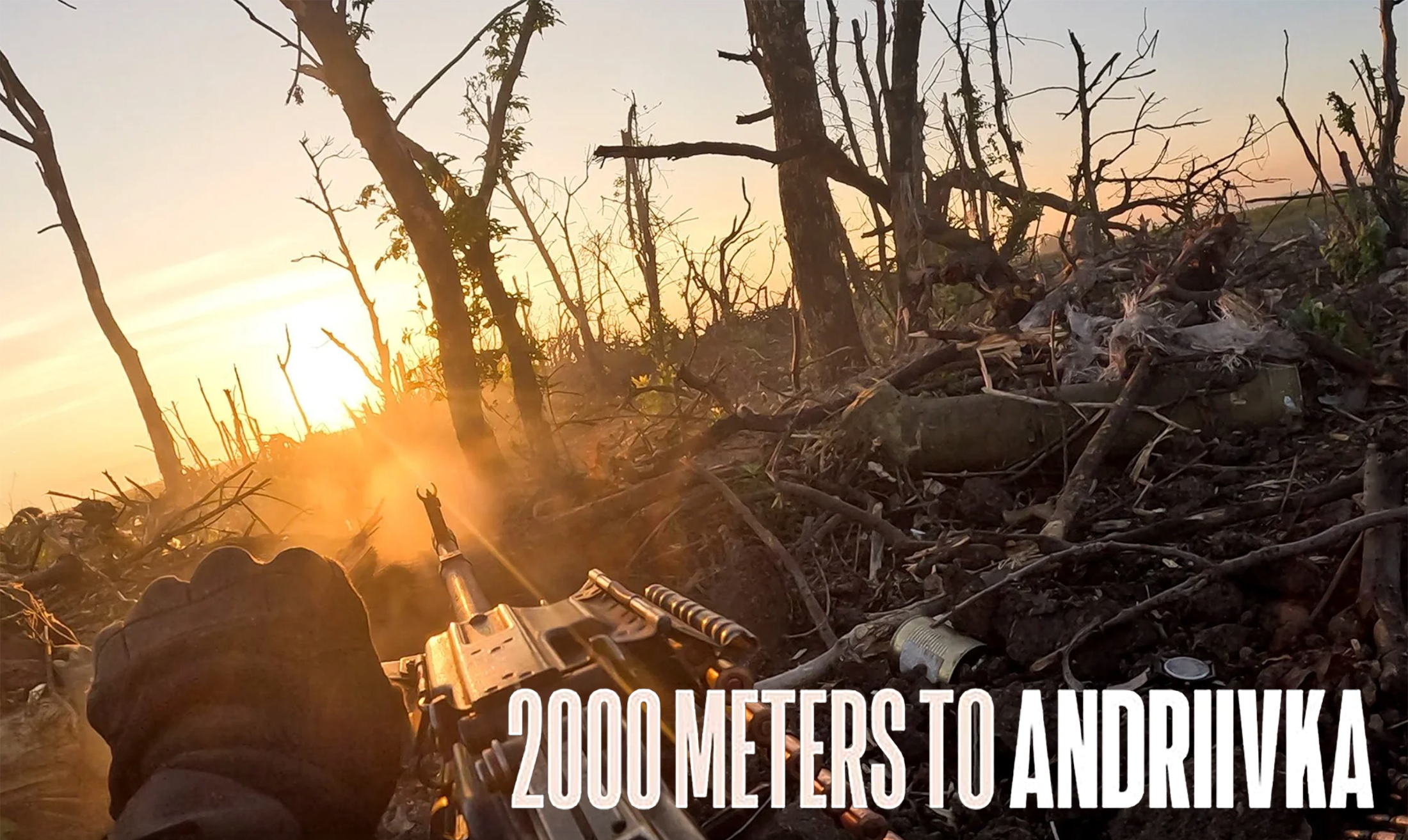
As it evolves, fleeting character studies of individual soldiers emerge organically from the chaos, each one a brief but indelible human portrait. The film never announces these moments — they arrive and recede, there and then gone, like the men themselves - a masterful structural choice.

It's rare that a documentary reinvents its own genre. Joshua Oppenheimer's The Act of Killing comes to mind — a film so singular in form and content that it permanently shifted what documentary cinema was understood to be capable of. 2000 METERS TO ANDRIIVKA belongs in that conversation. Like the Act of Killing, the formal originality of this masterpiece by MSTYSLAV CHERNOV isn't a stylistic exercise — it's inseparable from its argument.

Mstyslav Chernov's previous documentary, 20 DAYS IN MARIUPOL, is also fantastic and brave, but also adheres closer to tradition documentary canons. It deserved the Oscar it won.

But 2000 METERS TO ANDRIIVKA is more groundbreaking, hence its prizes in CPH Docs, Sundance, amongst many more. This is essential cinema. Uncomfortable and uncompromising as so many of the best works of art are.

Last Stop Larrimah, whodunnit dontmatter

Few can resist a good murder mystery, which is exactly what LAST STOP LARRIMAH is, albeit in larger-than-life documentary form.

Quite literally in the middle of nowhere in Australia's Northern Territory, the run-down and forgotten little town of Larrimah couldn't be any less assuming. The ten remaining residents (yes, ten) are like forgotten troops at an outpost. Few of them get along, which brings them all under police and national media scrutiny, given the unusual circumstances of the victim's disappearance.

Directed by Thomas Tancred and produced by the Duplass Brothers, Last Stop Larrimah honors the twists and turns any good murder mystery relies on. But what makes the film worthy of the silver screen are the surviving inhabitants of Larrimah. Even the murder victim, Patty, is an exceptional character, as portrayed in video recorded of him prior to his death.

Ultimately the movie is less about who committed the crime than about the strange circumstances surrounding it. The town and its inhabitants are straight out of a Tom Waits song, with that wonderful mix of humor, loneliness, quirkiness and tragedy.

LEAVE THE WORLD BEHIND, Aspirational Apocalypse

LEAVE THE WORLD BEHIND is an excellently crafted, low-maintenance thriller, perfect for those moments when we need entertainment while running on two cylinders mentally. Furthermore, it offers some pointers on riding out societal collapse in class and comfort — particularly useful in this day and age.

The film has healthy doses of creepy weirdness, punctuated by great camera work and a slick visual style entirely in keeping with the antiseptically luxurious lifestyle of its protagonists, including (but not limited to) megastars Julia Roberts, Ethan Hawke and Mahershala Ali.

Aspirational voyeurism has always been one of the reasons people flock to the cinema. Leave The World Behind is no exception, cooking up its own unique blend of 'luxorealism' — if things really did finally fall apart in western society, this is the kind of dishevelment you'd imagine the real Roberts, Hawke and Ali having to endure.

But the film is a fun watch for the whole family, doubling up as a glitzy Hollywood apocalyptic handbook for the 1% who left the world behind a long time ago.

ROBOT DREAMS, Dear 1980s NYC

A few days ago I put ROBOT DREAMS thoroughly to the test by bringing Ariane, my youngest daughter, and her posse to the Barcelona premiere. They loved it, as did I. Ariane and I both shed a tear or two.

Based on the popular graphic novel by North American writer Sara Varon, ROBOT DREAMS tells the adventures and misfortunes of Dog and Robot in 1980s NYC. And for anyone who knew, loved and dearly misses the city back then — the dollar-a-slice, Twin-Towers-still-standing NYC — you're in for a treat. The film is a pre-9/11 homage to the Big Apple like no other.

Director Pablo Berger hits a home run with this precious gem of a film. Robot Dreams is vintage by design, both in animation style and sound design, so it might feel a tad slow, given our ever-shorter attention spans. But this is our shortcoming, not the film's.

BEEF, An Ode to Imperfection

I can't recommend Netflix's BEEF enough. It's a provocative, funny, irreverent and charming dark comedy that captures the zeitgeist of 2020s California capitalism.

Creator and showrunner Lee Sung Jin's story twists and turns with the agility of a falling cat, while balancing its characters to perfection. Everyone is deeply flawed, yet charming and forgivable.

There's little more to say, except just go see it, if you haven't already. And if you don't believe me, check out the rave reviews on Rotten Tomatoes, the New York Times, Roger Ebert, Vox

FAIR PLAY, A Joyfully Dark Tale

Sundance Grand Jury Prize nominee, FAIR PLAY is a dark, acidic dive into the murky world of workplace sexism, relationship power dynamics and the negative feedback loop between the two. Edgy yet highly polished, the film is an incisive, sexy and provocative psychological thriller that keeps you on the edge of your seat.

Phoebe Dynevor, Alden Ehrenreich and Eddie Marsan all deliver solid performances, and writer/director Chloe Domont crowns herself as a confident writer, her script whittled down to its psychological core so economically that it could easily function as a stage play.

All in all, Fair Play is a great watch. And considering it's Chloe Domont's first feature film, it's an outstanding achievement. She's definitely a writer/director to watch.

Note: This week I decided that there's no place for bad reviews in this blog. My intention here is simply to collect films and series I've enjoyed watching and share a few thoughts about them. 'Ben's Recommends', so to speak.

THE CREATOR’s A.I. Script Fail

I've been agonising over writing this, primarily because I want these reviews to be about films I've thoroughly enjoyed. As a director I know only too well the Herculean effort required to make any movie, and resent film critics who take insensitive shots from a safe, opinionated distance. These critics do incredible damage to filmmakers and the industry alike.

Because of the stranglehold the majors have on distribution, independent cinema has it that much harder. The same goes for directors' first films, which I believe need to be critiqued in an entirely different category. But THE CREATOR is neither — it's far from the endangered species list — so I feel it's deserving of my humble two cents.

Regarding the film's merits, Edwards' visual spectacle doesn't disappoint — he is a technical wizard. His $86 million budget was modest for its visual scale, thanks to a brilliantly organic technical approach: he avoided green screens, shot on location with a skeleton crew using a prosumer ($3,000) camera and minimal lighting, then fully edited the film before unleashing the 3D artists. This approach gave it grittiness and authenticity, while looking as though it cost four times as much.

That said, suspension of disbelief should require no effort when it comes to movies, especially sci-fi. But even the first few shots of The Creator's opening scene stop making sense —

navy seals carry out a surreptitious approach while accompanied by a twenty-mile-wide doomsday skycraft with a huge beacon of light. It's one or the other, but not both. Act I hadn't finished by the time I'd tired of giving the script a pass.

In light of Hollywood's writers' strike about the threat A.I. poses to their livelihoods, rogerebert.com noted the irony of the timing of The Creator's release, given that the film's theme is a lesson in ethics for humanity by A.I. I find the irony more ominous still: considering how The Creator's plot twists, character arcs and dialogue are so often far-fetched or predictable, Edwards may have inadvertently fuelled the studios' argument in favour of using A.I. for creative writing.

WES ANDERSON’s Filmbookpaintings

Bravely expanding the boundaries of film, Wes Anderson digs deeper into his aesthetic in his recent collection of four short films — adaptations of Roald Dahl's stories: THE WONDERFUL STORY OF HENRY SUGAR, THE SWAN, THE RAT CATCHER and POISON.

Wes Anderson's brand identity is second to none, and he is one of the rare directors whose unique aesthetic has become synonymous with his name. Ironically, in a recent Deadline interview by Damon Wise, Anderson claimed he doesn't have an aesthetic — a quote that predictably ripped through the internet like wildfire. But he clarified, speaking of how aesthetics often develop from unexpected circumstances, a truism that applies to creative work in general, artistic or otherwise.

Anderson pinpoints the chance flooding of the baseball diamond set in Rushmore (1998) as having kicked off his formal aesthetic pursuit. His solution for that shoot day was to use long, symmetrical dolly shots to avoid the muddy field.

Anderson's dolly shots are alive and well in the four Dahl stories, along with his colour palette, theatrical set design and actors' deliveries. One could argue that these stylistic elements are

more rigorous than ever, born from his intention of having the Dahl stories literally read to the viewer. As Anderson playfully puts it, 'I like stories that are stories within stories and plays within stories and movies within plays within stories.' In this sense it's worth considering the four short films as filmbooks, with lines blurred between film, literature and theatre. But aesthetically, they're also filmpaintings.

What results are films so precious you want to frame them. Personally, I found Poison to be the most accessible, thanks to the tension and the brilliant intensity of Dev Patel, Benedict Cumberbatch and Ben Kingsley.

Kudos to Wes Anderson for his bravery in exploring an aesthetic to its fullest expression. We need more unique voices in film, and global platforms like Netflix provide the perfect venue to bring them to audiences. But they're certainly not for everyone, and expectations of the movie 'experience' should be kept in check.

BARBIE, The Blockbuster With An Indie Soul

BARBIE is a guilty pleasure, but also so much more. It's an irreverent, raucous, touching, over-the-top, complex and multi-faceted masterpiece, deserving of Oscar nominations for Best Picture, Best Director AND Best Original Screenplay. There, I've said it.

While Greta Gerwig's directing is glorious (and who can deny the film's slickness and meteoric box office results?), it's the script she co-penned with writer/director/husband Noah Baumbach that speaks truth to power and blesses Barbie with its quirky twists, irony and priceless dialogue. Look no further than arming Barbie with Birkenstocks and the Indigo Girls' 1980s anthem 'Closer To Fine' for her soul-searching in the real world.

The genius of the script is what elevates Barbie to a film d'auteur, and why The Guardian's review 'Has Barbie Killed the Indie Director?' is simplistic, highbrow clickbait unworthy of the publication. I'd humbly suggest The Guardian consider the alternate angle: 'Has Barbie Killed the Bad Film Critics?'

Greta Gerwig and executive producer Margot Robbie stuck to their creative guns throughout. Robbie conceived of the project, brought Greta onboard and then charmed Mattel and Warner Bros. into preserving every degree of its acidity. In Greta Gerwig's words, 'the story being what it is, it feels unbelievable that it's been made.' I couldn't agree more. Barbie's subversiveness and bravery keep it firmly rooted in the indie world.

My only criticism of the script (spoiler alert) would be its reliance on voter suppression to restore the natural order in Barbieland. But then again, the scene also blesses us with Ryan Gosling's rendition of 'I'm Just Ken', so all's forgiven.

Fun fact: Greta Gerwig and husband Noah Baumbach have each been nominated twice for screenplay Oscars. Were they to deservedly win for the Barbie script, it would be third time lucky for both. I'd settle for a nomination, and nothing less.

NOTE 12/2023: Since writing this, the 2024 Golden Globe nominations were announced. Besides leading the pack, Barbie was nominated for Best Film, Best Director (Comedy) and Best Screenplay. Justice has been served, for now.

NOTE 01/2024: The Oscar nominations were just announced, with two glaring omissions. Firstly, Greta Gerwig's masterful directing went unrecognised — best explained by Kyle Buchanan at the NYT as having four things going against it: Barbie being a big studio movie, a comedy, about a doll, and Greta being a woman. To note: 587 Academy members vote for the Best Director nominations. While only a quarter of them are women, votes come in from a respectable 93 countries — which may have been another factor against it, given that the film's kitsch, pop-art sensibility and continual US-specific references played best for an Anglo audience. Who knows. Secondly, Gerwig and Baumbach were nominated for Best Adapted Screenplay rather than Original Screenplay, simply because Barbie is based on pre-existing Mattel characters. Absolutely ridiculous, but not without Academy precedent. Judd Apatow summed it up best on X: 'It's insulting to the writers to say they were working off existing material. There was no existing material or story. There was a doll in a clear box.'